 Safety Glazing

Explore our certified structural aluminium bi-fold systems, thermal break swing configurations, minimalist sliding partitions, and tempered glass railings specified for Montevideo and Punta del Este architectural projects.
Safety Glazing
 Thermal Break
 Exterior Railing
 Balustrade
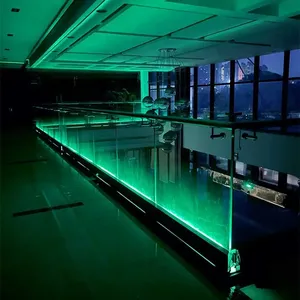 Smart Lighting
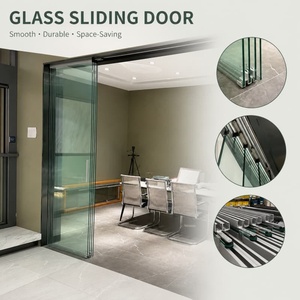 Interior Sliding
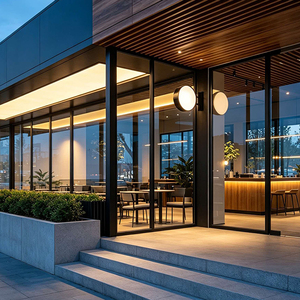 Curtain Wall
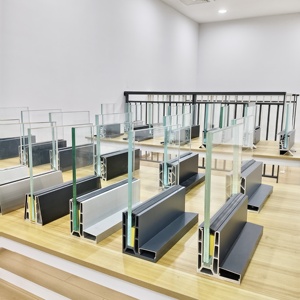 U-Channel Base
A rigorous examination of kinetic aluminium bi-fold engineering, addressing the intersection of extreme marine salinity, cyclonic Pampero gusts, and mandatory energy codes.
Uruguay presents a uniquely demanding macro-environment for large-span fenestration engineering. Nestled between the massive discharge of the Río de la Plata estuary and the open expanse of the South Atlantic Ocean, the country experiences an aggressive coastal atmosphere combined with rapid meteorological shifts. Architectural developments spanning from high-density residential towers along the Rambla of Montevideo (Pocitos, Punta Carretas, Carrasco) to ultra-luxury oceanfront estates in Punta del Este, La Barra, and José Ignacio increasingly demand floor-to-ceiling glass expanses that dissolve physical boundaries. However, achieving clear openings of 6 to 15 meters using aluminium folding doors without sacrificing structural integrity requires specialized engineering.
Standard commercial bi-fold doors frequently fail in Uruguayan coastal conditions due to three primary vectors: electrolytic coastal oxidation, kinetic hinge fatigue caused by cyclic Pampero and Sudestada wind loads, and uncontrolled thermal conductance resulting in high interior condensations during winter cold fronts. As dedicated manufacturers and international exporters serving the Uruguayan market, our multi-leaf folding systems are purpose-engineered with high-strength structural extrusions, polyamide thermal breaks, and marine-hardened kinematic components to ensure lifelong performance.
We utilize prime architectural billet extrusions with wall thicknesses from 2.0mm to 3.0mm, calibrated according to profile moment of inertia ($I_x, I_y$) to resist flexural deflection under sustained wind pressures exceeding 3,000 Pascals.
Integrated PA66 GF25 (polyamide reinforced with 25% structural fiberglass) thermal isolators decouple interior and exterior sash frames, achieving complete thermal bridging interruption and driving overall $U_w$ values down to 1.4 W/m²K.
Rolling carriages, multi-point lock rods, heavy-duty hinges, and guide pins are manufactured exclusively from marine-grade Grade-316 stainless steel, passing 1,500-hour ASTM B117 neutral salt spray testing without pitting or seizing.
A quantifiable comparison of structural, thermal, and mechanical thresholds designed to simplify tender documentation for Uruguayan architects and specifiers.
| Performance Criterion | Standard Market Fenestration | Al-Karam Heavy-Duty Thermal Break Bi-Fold | Compliance Reference / Standard |
|---|---|---|---|
| Aluminium Alloy & Temper | Recycled / Secondary 6063-T5 (1.2–1.4mm) | Virgin Ingot 6063-T6 (2.0–3.0mm Structural) | ASTM B221 / EN 755-2 |
| Thermal Transmittance ($U_w$) | 3.8 – 5.4 W/m²K (Unbroken frame) | 1.3 – 1.8 W/m²K (PA66 GF25 Thermal Break) | UNIT 1217 / ISO 10077-1 |
| Design Wind Pressure (Resistance) | Class 2 (1,200 Pa / ~150 km/h) | Class 5 (> 3,000 Pa / > 240 km/h Pampero rated) | EN 12210 / ASTM E330 |
| Air Permeability | Class 2 (Loose brush seals) | Class 4 (≤ 3 m³/h·m² Continuous co-extruded EPDM) | EN 12207 / ASTM E283 |
| Water Tightness Under Pressure | Class 4A (150 Pa infiltration limit) | Class 9A (≥ 600 Pa Cascading drainage sub-sills) | EN 12208 / ASTM E331 |
| Acoustic Attenuation ($R_w$) | 26 – 28 dB (Monolithic glass) | 38 – 44 dB (Asymmetric Laminated DVH Acoustic) | ISO 717-1 / ASTM E413 |
| Saline Corrosion Resistance | Standard Powder Coat (< 500 hrs salt spray) | Qualicoat Seaside Class 2 / PVDF 3-Coat (> 2,000 hrs) | ISO 9227 / AAMA 2605 |
| Carriage Load Capacity | 80 – 100 kg per panel (Nylon wheels) | Up to 300 kg per panel (4-wheel SUS316 bogie bearings) | EN 13126-15 Cycle Tested (50,000+) |
From saline Atlantic shorelines to historic riverine ports, our folding door configurations adapt directly to local microclimatic requirements and lifestyle customs.
Designed for multi-panel perimeter glass walls that open residences entirely to oceanfront terraces, swimming pools, and manicured dunes.
Engineered for high-altitude wind loads along the Rio de la Plata coast where wind pressure escalates exponentially with building height.
Catering to the quintessential Uruguayan social ritual of indoor-outdoor culinary gatherings (*el asado*) across suburban and country estates.
Large-format fenestration for winery tasting rooms, boutique coastal retreats, and upscale corporate conference pavilions.
How our manufacturing protocols align with national energy labeling standards and evolving architectural specifications across the Southern Cone.
The construction sector in Uruguay is currently undergoing a decisive transition toward high-efficiency building envelopes. Guided by national energy directives from the Ministerio de Industria, Energía y Minería (MIEM) and standards developed by the Instituto Uruguayo de Normas Técnicas (UNIT), developers are moving away from legacy single-glazed non-thermal break profiles. Projects submitted to municipal approval in Montevideo and Maldonado must increasingly demonstrate compliance with thermal insulation baselines to reduce peak seasonal electrical loads.
Our export assemblies are specifically configured to fulfill and exceed these statutory demands:
Our double-glazed sealed units (DVH) integrate warm-edge composite spacers, argon gas filling, and soft-coat Low-E layers that meet the rigorous thermal transmittance thresholds defined under UNIT 1217 and UNIT-NM 156, drastically reducing summer cooling loads and winter heat losses.
In accordance with architectural glazing safety directives, all glass panels used in our folding door configurations undergo thermal tempering or PVB/SentryGlas lamination, meeting human impact safety standards and ensuring that broken shards do not cause injury in coastal storm conditions.
With an increasing share of commercial developments in Carrasco and Montevideo seeking LEED or EDGE certifications, our thermal break folding systems contribute directly toward energy modeling credits, natural daylight harvesting indices, and indoor environmental quality metrics.
Drawing on over 15 years of precision architectural fabrication, custom CNC tooling, and an unblemished global delivery footprint.
We eliminate standard dimensional limitations. Every folding assembly is custom cut to exact opening millimeters based on precision laser surveys or CAD/Revit architectural drawings, accommodating unique ceiling heights, splayed bays, and custom corner layouts.
Utilizing high-tensile 6063-T6 / 6063-T5 alloy sections sourced from certified extruders, our profiles deliver superior structural rigidity, perfectly square 45-degree hydraulic crimped corners, and unmatched wind-load deflection resistance.
Prior to export packaging, every bi-fold door set is 100% pre-hung in our manufacturing facility. Rolling mechanics, gear alignment, gasket compression, and digital tolerances are verified and signed off by senior quality inspectors.
Exporting to the Port of Montevideo demands bulletproof protection. Our doors are wrapped in moisture-barrier film, cushioned with dense closed-cell EPE foam, corner-armored, and loaded into fully enclosed, fumigated ISPM-15 compliant timber crates.
We provide full documentation suites for Uruguayan customs clearance, including Bill of Lading, Certificate of Origin, detailed commercial invoices, packing lists, and technical specification dossiers to streamline nationalization at Puerto de Montevideo.
To assist local Uruguayan construction teams, we supply comprehensive step-by-step CAD installation guides, component numbering schematics, video walk-throughs, and on-call engineering video support throughout the site installation phase.
Authoritative technical guidance concerning importation, custom engineering, storm ratings, and installation procedures for aluminium folding doors.
We operate standard international shipping under Incoterms (CIF Montevideo, CFR, or FOB). Our export department prepares all required shipping manifests, fumigation certificates (ISPM 15 compliance for timber packaging), commercial invoices, and tariff classification codes (HS Code 7610.10 for aluminium doors and windows). Once the container docks at Puerto de Montevideo, your designated local customs broker (despachante de aduana) handles nationalization, payment of IMESI / IVA as applicable, and arranges overland bonded transport directly to your job site anywhere in Uruguay.
Yes. Our coastal folding door series is structurally engineered for elevated wind pressures. We utilize heavy-gauge 6063-T6 extrusions with an increased profile depth (75mm to 85mm frame depths) and internal structural reinforcements. The systems are laboratory tested to withstand dynamic gust pressures exceeding 3,500 Pa (equivalent to wind speeds over 240 km/h). Furthermore, multi-point compression locks engage at both top and bottom tracks every 800mm, while triple-lip co-extruded EPDM gaskets ensure airtight and watertight integrity during extreme cyclical driving rain.
For oceanfront properties in locations such as Punta del Este, José Ignacio, or Piriápolis, standard anodizing or architectural powder coatings are insufficient due to aggressive airborne sodium chloride. We mandate either Qualicoat Seaside Class 2 certified architectural powder coating or a minimum 25-micron class-1 marine anodized finish (available in natural silver, champagne, dark bronze, and black). Alternatively, we provide 3-coat fluoropolymer PVDF coatings compliant with AAMA 2605, which guarantee superior resistance against chalking, salt pitting, and ultraviolet color fading for over 20 years.
We provide engineered Doble Vidriado Hermético (DVH) setups tailored to your building’s solar orientation. A typical high-performance specification includes a 6mm outer tempered Low-E pane + 12mm or 16mm warm-edge composite spacer filled with 90% Argon gas + 6mm inner clear tempered or laminated safety glass. This achieves an overall center-of-glass $U_g$ value as low as 1.1 W/m²K and an assembly $U_w$ value of ~1.4 to 1.6 W/m²K, effectively preventing winter interior condensation and satisfying thermal baselines established by UNIT 1217.
Yes. We offer multiple threshold profiles: a fully weather-rated rebated step sill (which provides maximum Class 9A watertightness against torrential rainfall) and an ultra-low flush floor transition (sunken threshold) featuring hidden continuous drainage slots. For coastal terraces exposed to direct South Atlantic winds, we recommend our integrated cascading drain sill, which can be connected directly into the building's exterior perimeter drainage system while maintaining a step-over height of less than 15mm.
Custom manufacturing typically takes 3 to 5 weeks following shop drawing approval and color sample sign-off. Maritime transit from our deepwater container port to Puerto de Montevideo generally requires 30 to 40 days depending on the shipping line schedule. We provide complete real-time container tracking, bill of lading documentation, and coordinate container staging to align with your project’s construction timeline.
Whether you are an architect designing a coastal villa in José Ignacio, a developer planning a residential tower in Montevideo, or a general contractor seeking high-performance thermal break bi-fold door systems, our engineering desk is ready to assist with profile sizing, structural wind load calculations, and competitive CIF pricing.